
L&L Europe Settlement: Why Withdrawal Checks Need Earlier Decisions
L&L Europe’s £900,000 regulatory settlement puts the timing of customer checks under scrutiny. A withdrawal request should not become the moment an operator asks for information it could reasonably have collected earlier. That is one of the findings in the Gambling Commission’s October 21 announcement.
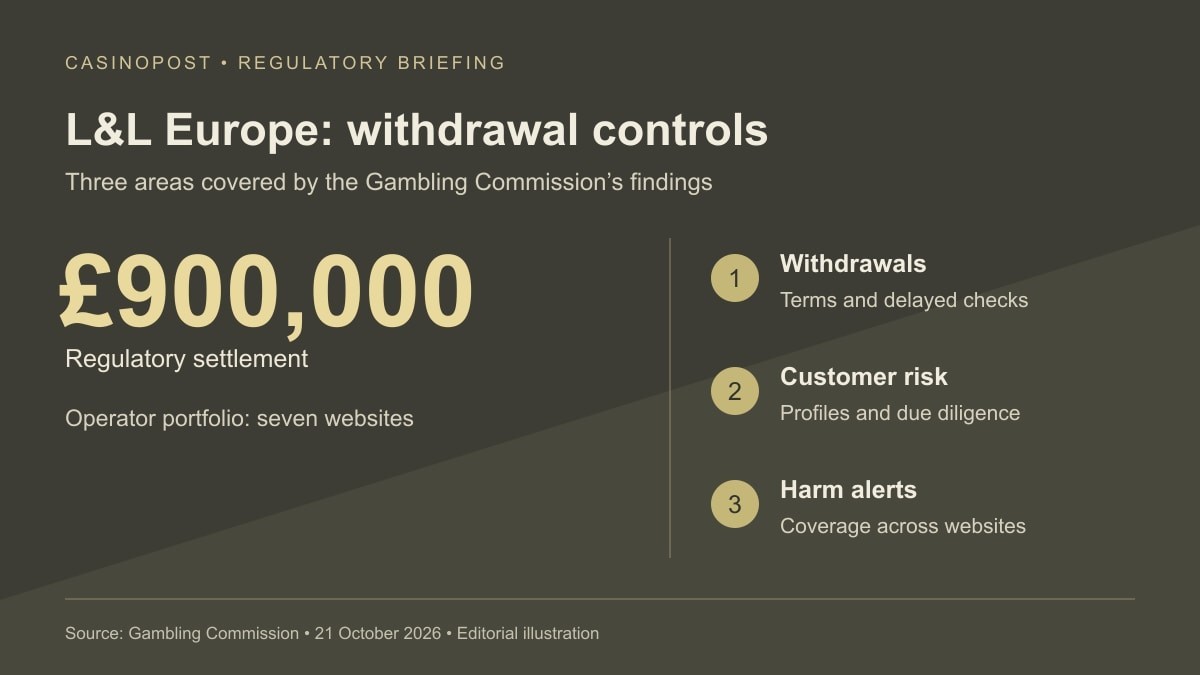
The regulator’s account covers seven websites operated by L&L Europe Limited, including allbritishcasino.com, casinocasino.com and hypercasino.com. It describes withdrawal, anti-money-laundering and social-responsibility failures. The payment forms part of a regulatory settlement; treating the figure as a measure of unpaid customer balances would misread what was announced.
Two payment practices caused problems
One term allowed customers to request only a single withdrawal at a time. They could not make another request until the first had been authorised. The Commission describes that condition as unfair under the Consumer Rights Act 2015.
The other problem involved manual reviews of every fifth or tenth withdrawal for some customers. Those reviews led to additional information being required before payment. The Commission’s rule concerns information the operator could reasonably have requested earlier.
There can still be legal reasons to seek information when somebody withdraws. The regulator explicitly acknowledges that possibility and says it did not explain this case. The practical distinction is whether a specific obligation calls for a check, or whether an avoidable information gap has been allowed to accumulate until the customer wants money back.
Regular sampling did not establish a risk profile
The anti-money-laundering findings address how checks were selected. Controls relied largely on financial thresholds and sampling at set thresholds, rather than customer risk profiles and risk factors.
The business also failed to follow its own due-diligence procedures. Examples included overlooking risks from newly opened bank accounts and funds not evidenced as originating from employment, business income or savings. A procedure existing on paper therefore did not establish that the relevant decision had been made for a customer.
Check the whole group of websites
Some safer-gambling alerts worked on certain websites without covering the operator’s entire suite. The examples concerned time spent gambling and failed deposits. The Commission also found no process for evaluating the effectiveness of the overall customer-interaction approach.
For a business running several brands, an alert functioning on one website offers limited reassurance about another. Reviewing coverage across the portfolio and reviewing what happens after an alert are separate tasks.
Our report on the Dutch regulator’s 711 withdrawal warning covered a different jurisdiction and a different restriction: mandatory wagering before returning deposits. Both cases make the design of payment controls worth examining. Neither supports a blanket claim that compliance checks are forbidden, or that every withdrawal must complete instantly.