
Ksa and Google Work on EU Gambling Whitelist as Legal Action Stays Open
The Netherlands' gambling regulator says a joint task force is working with Google on a gambling whitelist covering legal operators in the European Union. In an October 14 blog, Michel Groothuizen describes the project as part of negotiations with large platforms while the Kansspelautoriteit, or Ksa, prepares for possible legal confrontation.
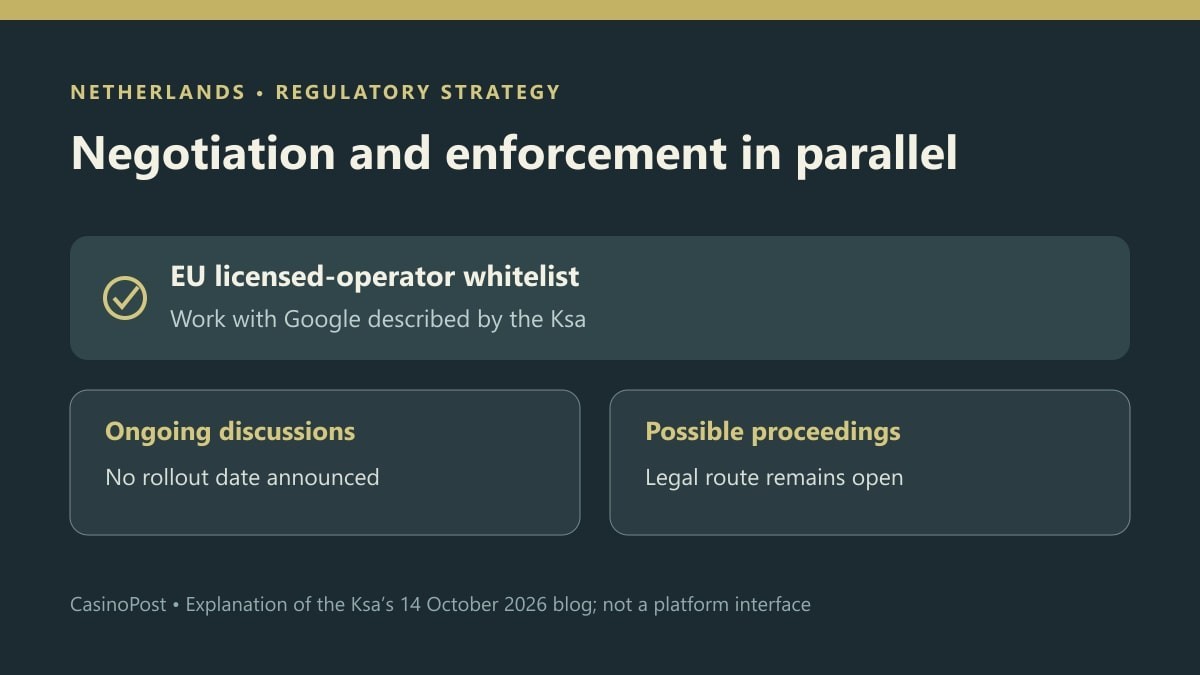
A proposed filter, with no launch date in the announcement
Groothuizen's account of the discussions says European regulators met Google and Meta in Dublin during the spring. He identifies a shared task force and work with Google on a list of legal EU operators, intended to help exclude other operators.
The blog does not give a rollout date, describe a finished list or announce that every related advertisement has already been blocked. For an operator or advertising supplier following the development, that distinction matters. There is a project to watch, rather than a completed platform change whose effects can already be measured.
The wider talks also should not be flattened into a single commitment from every company involved. Google is specifically identified in the whitelist work; the account describes broader discussions with Google and Meta. Those statements do not establish identical implementation plans at both platforms.
Why the regulator is pursuing more than fines
Groothuizen says fines against illegal operators send a clear signal but have had little collection impact. Over the past year and a half, the Ksa has also sought to make illegal offers harder to find and to disrupt payments to and from them.
His market comparison explains the concern. He puts the share of Dutch online gamblers playing exclusively with legal operators at about 90%, while describing money gambled in the legal and illegal markets as roughly one-to-one. Those are different measures. A large share of people using legal sites does not, on its own, show that a similar share of money stays in that market.
The blog supplies a policy argument, not a new statistical table with a reporting period and calculation method. Its approximate figures should therefore remain attributed to that argument, rather than be presented as precise new market-share measurements.
Cooperation is not a promise to avoid proceedings
The Ksa describes negotiations and evidence-building as parallel work. Groothuizen warns that a contested case could take years and says legal action remains available if voluntary efforts prove insufficient. He also distinguishes the Ksa's role from the European Commission's decision-making under the Digital Services Act.
For the industry, the immediate signal is pressure on the routes that make unlicensed businesses visible and payable. It sits alongside the regulator's separate work on licensed operators, including the bank-account verification guidance we covered earlier. Neither strand should be mistaken for evidence that the proposed whitelist has already solved the illegal-market problem.